
Welcome to the Guesthouse

This piece was first posted as the MindLetter for Welcome Week from the University of Edinburgh Chaplaincy. You can subscribe by emailing mindfulness@ed.ac.uk. 

They’re here! 

Music thumps joyfully from open windows. Cars filled with suitcases and duvets have descended on Newington. On the Meadows, small gaggles peer at iPhones. ‘I have no idea where we are,’ says a girl in a cropped top, braving an Edinburgh autumn. ‘I think Marchmont is this way.’  

If it is you with the iPhone, the duvet, the joy: you have travelled a long road to get here. Over the past six months, your education was profoundly disrupted. Your plans were so thrown into the air, you may have thought twice about coming to university at all. Perhaps you were one of many thousands whose grades were affected by the A Level debacle, and you tossed and turned for sleepless nights before your place here was confirmed. And – bigger, deeper, more visceral than these – you or your family may have been unwell, and suffered great losses.  

Welcome. We’re so glad to see you.  

If it is you, returning, with your University of Edinburgh hoodie that says ‘I’ve been here before’, and your vocabulary that is fluent in King’s Buildings, EUSA, and George Square: things are going to be a little different this year. You learned a lot, in spring and summer, about yourself and how you work. Lockdown may have suited you: with less travel time and social pressure, it may have given you a strange and unlikely freedom. Or it may have pushed you to your limits. Perhaps loved ones felt far way, and ennui, procrastination, and imposter syndrome flourished in isolation.  

Welcome back. Let’s be COVID-weary together.  

The word ‘welcome’ derives from the Anglo-Saxon word ‘wilcuma’, which means desired guest. Every summer, the guesthouse of the University empties, shuffles around the room allocations, and prepares to refill. To feed the hungry minds about to descend, we re-plan lectures, rebuild bookings systems, catch up on new research, tot up finance, rethink courses, streamline admin chains. We brush off old ideas and assess them for waterproofing. At some point, exhausted, we take a holiday. And then we cancel the autoreply, and open the front doors. 

This year we have done much more than that. Our staff and students have responded to the COVID crisis with extraordinary dedication and perseverance, often during considerable personal struggle. They have thought out, in microscopic detail, every implication of what it means to run a hybrid class, and have a certain flow of people through a particular corridor, and determine that those living, working, and studying in our buildings will be safe, and ensure that amidst the greatest public health challenge in a century, ideas, debate, and excellence can thrive.  

This is because you are desired guests. You come under our roof, for a year or three, and we give you a home base to venture into new worlds: Shakespeare, the Scottish philosophers, the poverty of historicism, nanotechnologies, postcolonialism, the best of the worst political orders, the ethical turn in anthropology, biomarkers for dementia, the quirks of the quark, and, just maybe, emerging zoonotic diseases.  

You will talk, and write, and argue, and forge intellectual alliances. Your presence is very much desired – in part, because we know that you are with us only for a short time. While you are here, we want to give you opportunities of mind that you will carry with you when you go, that will nourish your curiosity in dark times, and expand your sense of what’s possible in the good.  

And – here is something else about guests. Sometimes they are unexpected.

‘This being human is a guesthouse,’ wrote the thirteenth-century Sufi poet Rumi: 

Every morning a new arrival. 

A joy, a depression, a meanness,
some momentary awareness comes
As an unexpected visitor. 

It happened in the thirteenth century, and, particularly in these new circumstances, it may happen now. You open your suitcase when you arrive or come back, and discover that nestled alongside your Tefal pan and Bluetooth speaker, there is trepidation; loneliness; doubt, and self-doubt; there are a million questions, rolling through your mind like beads from a broken string.  

And if you are the steward of the guesthouse, with your pre-recorded lectures, and vast spreadsheet of contingency plans, and dizzying list of Zoom links, and fluorescent ‘keep your distance’ signs flashing before your eyes when you close them to sleep at night – you may be disappointed, weary, self-critical.  

Guest and steward alike may wonder: how do I respond to these guests? 

This is what Rumi suggested: 

Welcome and entertain them all!
Even if they’re a crowd of sorrows,
who violently sweep your house
empty of its furniture,
still treat each guest honorably.
He may be clearing you out
for some new delight. 

Now, neither ResLife nor the Estates Furniture Store will be thrilled if guests start flinging furniture around. But sometimes, Rumi seems to say, there are some really fine sofas waiting in the wings – and things get uncomfortable first. The chair breaks beneath you, and those beads from the broken string turn up in your socks.  

Be grateful for whoever comes,’ writes Rumi, ‘because each has been sent as a guide from beyond.’ 

The loneliness lurking in the suitcase, painful though it is, is doing something important. Things are, after all, not quite as you wished them to be. Acknowledge that; mourn it a little. Let it move through you, so that after a while, you can sit up, and blink, and start to sense this community as it is, alive and thrumming. Connection is in the fabric of a university; it has been carefully built, not just over a summer, not just to meet the challenges of COVID, but over decades and centuries. So don’t dwell in your loneliness for too long. You are our desired guest, and there is a seat at the table for you.  

And when you are the steward, and you are weary – your weariness is welcome. Make space for it. Lie low, where you can, and replenish; take a breathing space, over and over, if you need. Then, delight in the curiosity and energy of our guests. Alongside the tiredness, and the shiny fluorescent signs that say ‘keep your distance’, and the million questions rolling like beads all over the floor, we are so pleased to see them.  

Welcome, whatever you carry in your suitcase at the start of this semester. It’s going to be an adventure, and there will be some Fawlty Towers moments. But we have strong foundations, exceptional people, and great scenery. The front doors are open. See you soon.

© The University of Edinburgh. No part of this content may be used without prior written permission of the copyright holder.

The Escape Artist

Avoidance and Other Disappearing Acts

This piece was first posted as the MindLetter from the University of Edinburgh Chaplaincy. You can subscribe by emailing mindfulness@ed.ac.uk. 

You have a meeting first thing, and you’re thinking about the email that came in at 6am. ‘Ready for school?’ you say to your child in the kitchen. The child is quiet, and looks withdrawn, as they have done for some time. You have to get to your meeting, so you head to your study.  

Your dissertation is due in a month. You are not sure what you are writing, and you are worried. You’re reading and making notes, but it doesn’t seem to be going anywhere. Hours go by. You have not achieved enough to earn a weekend off, so you try to work, but you seem just to wind up on Instagram. You are tired, and scared about the deadline.  

You have been living on your own during lockdown. It’s tough, and you have been drinking more than usual to wind down after work. You feel groggy in the mornings, and so you stop going for your run before work. This means you don’t sleep well, so you have an extra glass after dinner, too, to help you drift off. You slow down at work, and are starting to forget things.  

Do any of these look familiar to you? One of these scenarios may resonate more than others, depending on whether you are a parent, a student, a runner, or all of the above; whether you live alone, or not; whether you are a morning person, or not. 

But what ‘too much’ really means is that your personal history, multiplied by the unique set of circumstances in which you find yourself in this moment, divided by the resources you have to meet it, equals more than 1. The parent’s meeting is perhaps the culmination of a big project; his child’s unhappiness makes him uncomfortable, because he was unhappy at that age, too. The student was a star pupil at school, but she has no job lined up for when she graduates, and she is terrified of failing. The runner was doing OK despite the lockdown until her cat died, suddenly.  

The balance tips. It happens to all of us. And when stresses are multiplied, as in exceptional times, we may be surprised at the strength of our own reactions. But in the simplest terms, when you are operating at more than 1, you start running on an energetic and emotional deficit. What happens next

1.     The Stress Equation

As the camera pans over the Edinburgh skyline, the setting for our story becomes clear: it’s stress. It’s seeping up through the floorboards, washing around the main characters as they head to the meeting on Teams, sit grimly at the computer on a Saturday, and turn off the alarm, groggy and headachy.  

Simply put, the parent, the student, and the runner are experiencing stress because they are experiencing too much: information, emotion, time alone, unstructured time, maybe even red wine.  

‘Too much’ is, on the one hand, subjective. We all know someone who can take phone calls while also brilliantly comforting their child at 6am, or spend weeks happily in their own company, or down several pints on a Friday night and come top of their age group in the Park Run the next morning. This means that we may be tempted to tell ourselves, if we are struggling, that we are ‘being weak’. When it comes to others, we may indulge in competitive stressing, to establish that we have more to be stressed about than they do.  

But what ‘too much’ really means is that your personal history, multiplied by the unique set of circumstances in which you find yourself in this moment, divided by the resources you have to meet it, equals more than 1. The parent’s meeting is perhaps the culmination of a big project; his child’s unhappiness makes him uncomfortable, because he was unhappy at that age, too. The student was a star pupil at school, but she has no job lined up for when she graduates, and she is terrified of failing. The runner was doing OK despite the lockdown until her cat died, suddenly.  

The balance tips. It happens to all of us. And when stresses are multiplied, as in exceptional times, we may be surprised at the strength of our own reactions. But in the simplest terms, when you are operating at more than 1, you start running on a deficit. What happens next

2.     The Escape Artist 

The main character of our story is not the parent, the student, or the runner. The main character is the mind. 

The mind under stress typically responds in one of two ways. It may jump in and try to solve the problem: fixating, ruminating. The parent, up too early reading emails, is doing this. But then something else happens – the child is unhappy – and rather than jumping in, the mind withdraws. The parent literally leaves the room. 

Later, he may berate himself for not lingering a little longer; he may even internally accuse himself of being a ‘bad parent’. But this is the same mind that learned, on a visceral level over many millennia, to bolt at the hint of a large be-furred face in the grassland. The mind looks to escape under stress for very good reason: there are times when running, jumping, or flinching can save our life. Lions aside, avoidance of what’s difficult makes an awful lot of sense. And usually, it’s fine to wait until the meeting has passed to check in with the child; it’s sensible to question whether your thesis is going in the right direction; a glass of good wine is a pleasure in a quiet evening.  

The problem arises when we get really good at it: when the deficit accumulates over time, as with chronic stress, or happens all at once, as with trauma. When this happens, the mind turns escape into an art form, and the mind will react to emotional threats as if they are lions. Fear that our child is unhappy, fear of the future, or frustration with a lonely lockdown, morph into a be-furred face. And so we may leave the room either literally, or metaphorically. The student hides from her thesis; the runner disappears into Scotch.  

What happens next? 

3.     Escalation 

Here’s the thrust of the plot: if the mind chronically escapes, things may get worse before they get better. A child’s silence stretches into months, and the parent retreats into work. The dissertation is fumbled together in a sleepless last week, and the student’s self-criticism is entrenched. Perhaps the runner, who no longer runs, slides into depression.  

Things get worse because escaping, well-intentioned as the fight/flight system is, moves further away from the emotional nub of the matter. Emotions like fear, anger, and sadness are as old as the first human who ran from a lion. But for the stresses where fleeing doesn’t work – with the child, the dissertation, the loneliness – we must try something else.  

What might that look like? 

Photograph of a woman running on a road away from the camera. There are trees in the background and the sun setting

The escape artist thrives on two things: automaticity, and isolation. Interrupting its Cirque-du-Soleil-type flight through the air means addressing both of these. 

First, step out of automatic pilot. Learn to recognise your triggers, and your reactions. Which scenario above did you relate to? Which cause of stress, and which response? You may find it helpful to write these down, in a diary, or on a post-it.  

When you can start to recognise these as they occur in daily life, you are already doing something different. In the moment that you spot it, pause and settle yourself with a three-step breathing space. Later, put aside twenty minutes to explore it in more depth, with a RAIN practice. 

Second, step out of isolation. We often feel tremendous shame around our stress responses. We may perceive that they make us look weak, or fear that they will burden others. But they are as human as the very blood in our veins, and you are not alone. Message a loved one, or call someone you trust.  

We can make sense of the stories that we carry inside us; we can catch our own escape artist in the act. Some will surrender their running shoes swiftly, others may take more patience, inquiry, and support from outside. But the genre can be changed. The next act is unwritten.

© The University of Edinburgh. No part of this content may be used without prior written permission of the copyright holder.
A Wild Remedy

This piece was first posted as the MindLetter from the University of Edinburgh Chaplaincy. You can subscribe by emailing mindfulness@ed.ac.uk. 

If you ever have occasion to pack a large suitcase that will be lugged, by yourself, 400 miles on trains across the country – trains that will inevitably run late, incurring a hair-raising three-minute connection at Birmingham New Street – you will probably not want to pack hardback books. But over five months of lockdown in the south, I had read a few pages of Emma Mitchell’s The Wild Remedy nearly every day. So in it went, all the way to Edinburgh.  

Mitchell, who has suffered from persistent depression for over a decade, is a naturalist who regularly appears on Countryfile and Springwatch. Her Twitter and Instagram pages are alive with photographs, drawings, and crafts: an arrangement of June flowers; a brown wren; a silver cast of a snowdrop. The Wild Remedy, her illustrated diary of nature-watching, was first published in 2018, but it proved so popular during lockdown that it sold out across retailers nationwide. On opening the book you can see why: it’s like entering a natural cabinet of curiosities. Her simple pen and ink drawings of hawkbit, a barn owl, a feather, ask the eye to linger, to note lines and form. Photographs abound with greenness. Turn the page, and find yourself transported to a field of orchids; startle, when you recognise in black and yellow watercolour, the caterpillar you saw yesterday on a bramble.  

Mitchell’s relationship with nature is a joyful seizing of the present moment, amidst the poignancy that things pass. ‘I want to stuff all this colour hungrily into my eyes and pockets while it lasts,’ she writes of the indigo sloes and glowing beeches in autumn. She collects and photographs shells, pine-cones, and seed-heads, lovingly arranged for the reader and then dispersed. Against a plain background you see colours, shapes, and shadows; the texture of wood, the filigree of leaves; and you know that this is a moment in time, a capturing of the present, the sweeter for its fleeting.  

Mitchell’s daily walk, you sense, was vital for her long before it became so for many of us during lockdown. ‘Vital’ is apt, because although her depression is at times severe, this book is not so much about suffering as life-affirming relief. When Mitchell, like John Clare, ‘drops down’ to the level of the rock pool or the hedgerow, the ‘jagged edges’ of her thoughts lose their harshness, and her mind is soothed. She is a Romantic for the twenty-first century, and so she speaks both of mental health and soul; the importance of her medication, and the burgeoning of spring; the mycobacterium vaccae in the soil whose proteins trigger serotonin release in the brain, and the itinerant swallow as a symbol of persistence. ‘It has reached its destination and I have survived another winter,’ she writes.  

But, she warns, our connection with nature is not a one-way street, ‘a sort of green Tesco, burgling myself some green serotonin and dopamine. It’s much more of a two-way relationship.’ Contemporary readers’ love affair with nature writing can seem misplaced amidst a climate crisis, and Sarah Moss, in her haunting Ghost Wall, pastiched the kind of reader who stocks up on Robert MacFarlane and Richard Mabey but never goes outdoors. While Mitchell’s photographed arrangements are beautiful, with a vaguely coffee-table quality, they demand not so much to be looked at as emulated – and then, protected. You want to bring home robin egg shells, and protest Cambridgeshire County Council’s felling of bee orchids, too. And so when Mitchell laments a loss of biodiversity, this is not just another narrative. It hits the reader precisely because her work is visceral, as earthy and joyful as it is sometimes painful.  

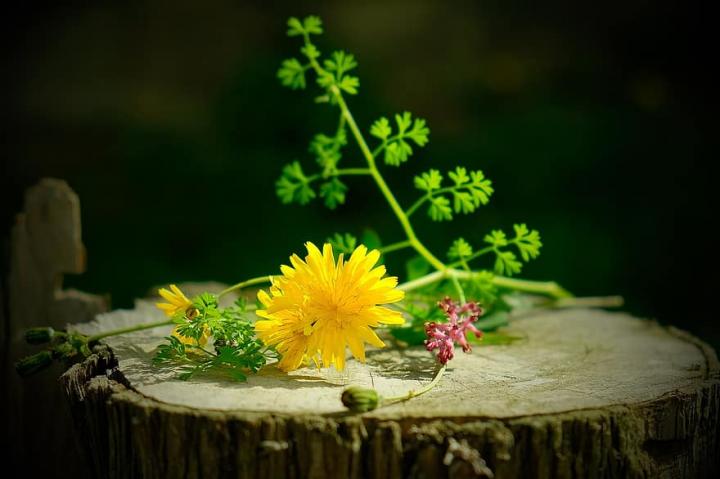
Photograph of a dandelion lying on tree stump

It is perhaps no surprise then that over the last few months, in daily lives typified both by anxiety and by ‘exercise outdoors’, The Wild Remedy flew off the shelves. Life in lockdown has interrupted so many of our connections. Entire relationships are conducted over Whatsapp; socially distant walks begin and end without hugs; love, mediated by Virgin Media, is susceptible to thunderstorms. The outdoors, on the other hand, can be seen, and smelt, and watched. The ground is damp when you kneel on it, and lichen is crisp between the fingers. Perhaps the gift of nature writing during this time is that when Zoom triggers fatigue, and screens make us want to wriggle, we feel our connections elsewhere more deeply.  

Mitchell leaves us with the knowledge that it is attention that creates connection, and presence that incurs discovery. These need not be hard work: a few pages of a book, at bedtime; being mindful, as you walk; a three-step breathing space, when you step outside. Then, miraculously, a darting smudge of green becomes a goldcrest. A bankside scurry becomes a vole. And when you return home after five months away, there are purple mushrooms in the Braid woodland, and wild raspberries in the hedgerows.  

© The University of Edinburgh. No part of this content may be used without prior written permission of the copyright holder.
Responding Wisely to Sadness

This piece was first posted as the Mindfulness Virtual Drop-in from the University of Edinburgh Chaplaincy. You can subscribe by emailing mindfulness@ed.ac.uk. 


A couple of weeks ago, I wrote about how a holiday – amidst its blessings – can create a space in which feelings that have been accruing emerge, sometimes unexpectedly. This is particularly true in difficult times. When things are urgent and important, we barrel through, and place things on the emotional shelf to be dealt with ‘later’. ‘Later’ can come as quite a surprise: the writer Elizabeth Gilbert, describing the loss of her partner, says of her grief that it comes in waves, and she usually gets about five seconds’ warning that one is coming.

Sadness, in particular, is such a powerful human emotion that when it wells up in us, we react equally powerfully. We often try to push it away: we tell ourselves that we have to get through the workday, so we can’t afford to be sad; we remind ourselves how much sadder other people are; we decide that we must be strong for others, or that there’s no reason to be this sad. It can be wise, sometimes, to place something carefully to one side; to say, ‘I know the time will come, and it is not now.’ But when sadness persists, we can feel swamped by it. It takes over our thoughts: how can I fix it, why am I all alone with it, it will never go away. We can get angry with it, and ourselves. And yet – here it is, heavy, solid. It wants something. What?

When sadness returns, it is because it wants to be felt. We resist it, as human beings, because we fear that if we allow it to be here, we may crumble once and for all. But in the end, trying to hold back sadness is like trying to hold back the waves. We can try: we come up with brilliant techniques, like drinking too much or working too hard, that seem to keep it at bay for a time. But sadness wants to wave through. When we are sad, it is because something important has happened. And so to respond wisely to sadness, we need to feel the water in our hair, and the salt on our skin, in ways that will tend it as it needs.

Last week, we looked at how to ground and settle the attention for a sense of safety and resource, and how helpful this can be when followed by Tara Brach’s practice RAIN. Here, now, is what my Oxford colleague Chris Cullen calls a GRAIN practice – Ground, Recognise, Allow, Investigate and Nurture – for times when sadness is here.

You might wish to do this sitting down, or, if you feel particularly agitated, on a walk, where you can pause or speed up as you need.

Ground 

Feel your feet on the ground – the texture of the carpet, floor, or earth. It can be good to take your shoes off for this, and really feel the contact with what is holding you up. If sitting down, sense your sit-bones on the chair or floor. Spend some time here, allowing your awareness to pool and settle in the base of the body, almost as if your body were a mountain, reaching down into the ground.

Recognise  

Notice what emotional tone is present in your experience right now. Sometimes, when we go to look for sadness, we find numbness. Looking more closely, there may also be anger, or anxiety, alongside sadness. Notice if the mind pulls you to thinking, and narrative. Some of our most compelling thoughts are images: a strong memory may pop up, or a visualisation of the future. See if you can name, internally, the emotions that are around: ‘here is sadness,’ ‘here is anxiety.’

Allow 

Touch back in with the sense of the soles of the feet, and your seat. Feel how sadness can be here, and your contact with the ground is also here. Bring a sense of gentleness and allowing to the feelings, knowing that it’s OK that they’re here. You might even say, internally: ‘here it is. Here it is.’

Allowing your sadness to be here is not the same as resignation to what is causing you pain. Rather, it’s acknowledging that it is OK for you to feel the way that you feel about it. When we fight sadness, it often intensifies, as it asks, louder, to be heard. So hold it gently. Know that the ground can hold you, amidst it.

Investigate 

Notice what sadness feels like in the body, and name this. It could be heaviness in the stomach; you might feel cold, or as if your body wants to curl up in on itself. Notice, too, your reaction to the sadness – there may be a sense of trying to push it away, or problem-solving. Note this, gently, and check back in with the soles of the feet, and your seat. These are always here to support you.

Nurture 

As you attend to sadness in the body, the body may well tell you what it needs. If it wants to curl up, then curl up, and pull a blanket over you, and rest for a while. If tears come, give yourself space to cry. Sometimes, it helps to drop in the question, softly: ‘what does this need?’ Listen to what comes back: a thought, an image, a spontaneous movement. Give yourself permission to follow this through, however small it seems.

Naomi Shihab Nye, in her poem ‘Kindness’, writes:

Before you know kindness as the deepest thing inside,
you must know sorrow as the other deepest thing.
You must wake up with sorrow.
You must speak to it till your voice
catches the thread of all sorrows
and you see the size of the cloth. 

Sadness can feel as though it is just ours, and we are alone in it. But it is so very human, and the size of the cloth is the size of all of us. As you tend your sadness, sense that you need not bear it alone. This is something that we share, that we carry with and for each other. Read your favourite poem, or call a loved one; as you sit or walk, give the sadness to the ground, and allow the ground to carry some of it for you.

If we have pushed sadness away for years, there may be a lot of sea waiting to come through. When we finally begin to listen, it can feel as if we are feeling all the sorrow of the world. It may shock us, how much sadness is here, and it can feel as if our head will never emerge from beneath the water. You may find yourself grimly pushing through GRAIN, teeth clenched, determined to feel it all and be done.

We don’t need to heroically purge ourselves of our sadness; that is only another form of trying to push it away. We honour it by attending, with gentleness, and care. Sometimes, that means sitting down with it, giving it space and time, perhaps with another person to help. Sometimes it means acknowledging sadness very lightly, greeting it as it laps at your feet. There may be days, weeks, and months of your life where it is entirely appropriate simply to Ground, and Recognise, and Ground again – maybe with the breathing space.

A wave rises and falls; this is its nature. It rises, as it seeks to make itself felt. It falls when we plant our feet firmly on solid ground, when we recognise the wave for what it is, when we say ‘it’s OK that this is here,’ when it moves through the body, and when we care for ourselves in its midst.

As we allow ourselves to feel the water, and taste its salt, we emerge, blinking, into the sun.


© The University of Edinburgh. No part of this content may be used without prior written permission of the copyright holder.

Going to Ground

This piece was first posted as the Mindfulness Virtual Drop-in from the University of Edinburgh Chaplaincy. You can subscribe by emailing mindfulness@ed.ac.uk. 


A few weeks ago, on a morning walk, I came across a spectacular carpet of morning glories. Otherwise known as bindweed, these marshmallow pink flowers grow rapaciously on scrubby ground in the summer months. True to their name, they are open and most glorious first thing, when the sun is up; by the afternoon they have folded in a tight pink whorl, waiting for the next beams of morning light. In gardens they are often uprooted, but if left undisturbed in farmland and hedgerows, they will roam over the ground without limit, like a green and pink web of delights for visiting bees and butterflies.

There was no other way to appreciate these ground-dwellers on a glorious morning: I sat down on the sun-baked earth, and settled in to watch the flowers and their visitors. Slowly but surely, peace, like the beetles, crept over me.

When we think of going to ground, it often has a fearful quality. We think of how rabbits disappear into their burrows at approaching footsteps, or a mouse bolts below the skirting boards. Indeed, with no burrow in sight, it is a profoundly animal pattern to drop to the ground in times of terror or distress: think of how a gazelle cornered by a lion will freeze, and fall.

Humans are just the same. In a moment of shock, we crumble to our knees, or say, ‘I need to lie down.’ In Eat Pray Love, the writer Elizabeth Gilbert describes how during the years of the breakdown of her marriage, she spent nights on the bathroom floor. The ground offers us something: as I wrote a few weeks back, even being in contact with it through walking activates the pressure receptors in the soles of the feet, helping to meet the body’s neurological need for touch.

To see what the ground gives back, you might watch how that gazelle, apparently felled, can bolt for freedom at the predator’s momentary inattention; how a human’s blood pressure rights, as they fold to the floor in a faint (ouch); how Gilbert’s prayers on the floor opened her to a guiding voice within. Going to ground gives us time. It allows us to replenish. Indeed, given the time of year, and your need for a holiday, many of you as you read this may actually be horizontal – or wish you were.

But the ground is not only palliative. As the dancers among you will attest, our bodies’ relationship with the earth is also the source of some of the most beautiful forms of art. Watch a contemporary dancer roll and lift from the ground, in a seamless wave of motion; or a Cuban salsera, or a tap dancer. You will see how going to ground does not only restore us to baseline: it makes new and rather wonderful things possible.

Here, then, is some ground beneath your feet this week.


  1. GRAIN, For Hard Times

I’ve introduced Tara Brach’s RAIN practice to you before as a way of responding wisely to fear, worry, and illness. The practice’s four stages – Recognise, Allow, Investigate, Nurture – are a very helpful way of using your attention to explore and tend to the experience of stress.

Sometimes, however, if distress is acute, or RAIN is unfamiliar as a practice, it is difficult for us to move attentively through this process without losing the thread, or getting sucked into the worry. My colleague from the Oxford Mindfulness Centre, Chris Cullen, talks about the value of Grounding first, by sensing the feet on the floor, and the seat on the chair. This allows the mind to begin to shift mode out of the fight-flight response. Indeed, once you have grounded, and are moving through RAIN, you might return the attention to the feet and the seat, in between its stages, to help steady the attention as you explore the practice.

In particularly sticky moments, simply attend for a few minutes to the soles of the feet on the floor, and the sit-bones on the chair. ‘FOFBOC’ – succinctly standing for ‘feet on floor, bum on chair’ – was developed by the Mindfulness in Schools Project, as a brief practice to help teenagers’ minds to settle at the beginning of class. It’s a great one to do regularly, so that the attention learns to settle in these places, and your ground is ready and waiting in the moments you need it.


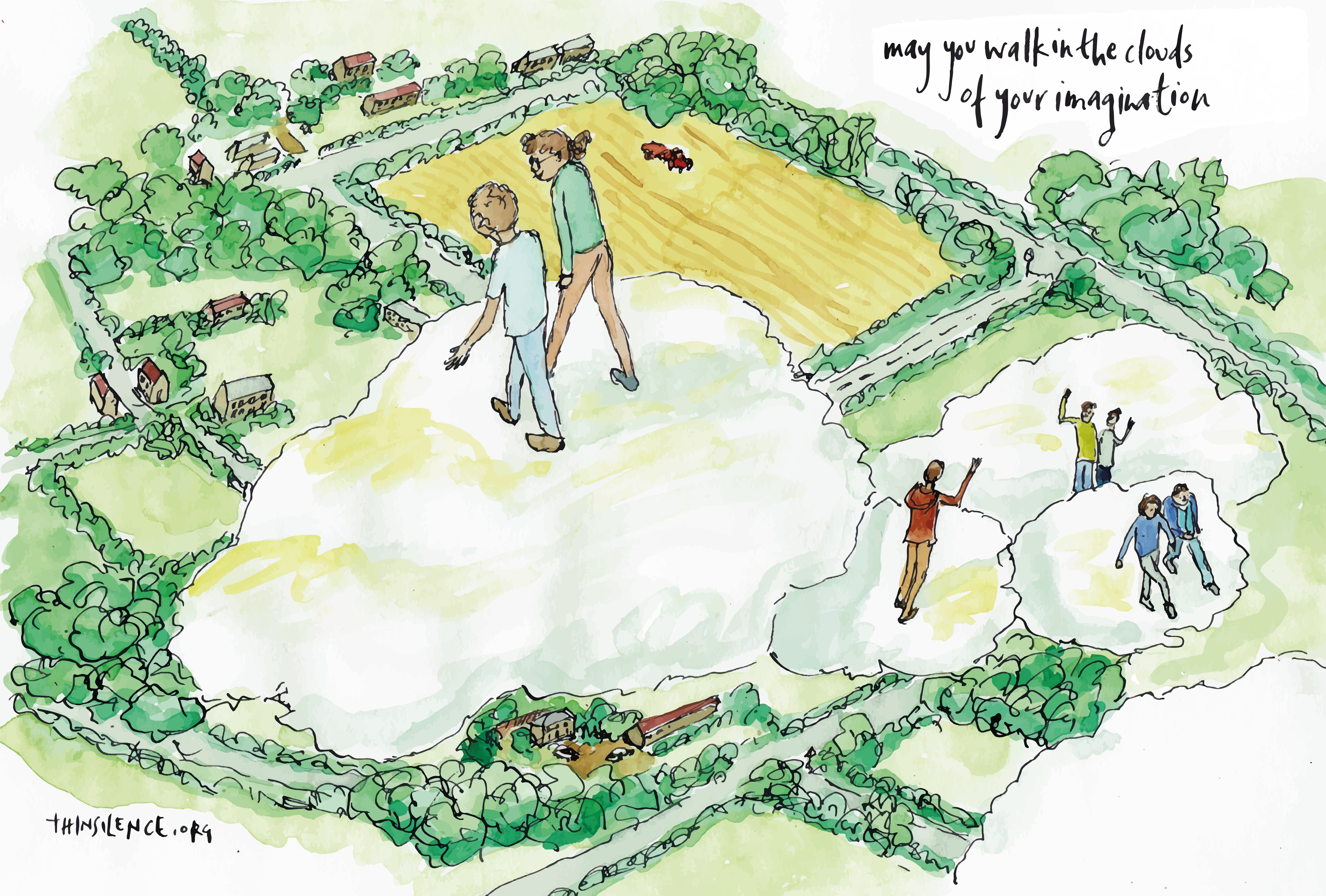
  1. Your Head in the Clouds

Leaving the ground can be one of the most exhilarating experiences known to humans. Think of the plane taking off to a faraway land, the phrase ‘flight of fancy’, the rollercoaster, the simple pleasure of climbing a tree. There is a reason that the penthouse is the preferred floor.

Extraordinary things can happen when we go up. But we also sense, with animal blood in our veins, that leaving the ground carries a risk to it. Those who are afraid of flying, who prefer the stairs to the lift, are in touch with this very basic fear. The idea of strange and frightening things happening when we go too high appears across literature; think of Mrs Rochester in Jane Eyre’s attic, or the vicious Knids in Roald Dahl’s Charlie and the Great Glass Elevator. Dahl, who was an RAF pilot during the Second World War, was well aware of what can happen in the sky.

One of the most interesting facets of creative thought is that it takes what is already here, and transforms it into something new. Creativity is literally grounded. The plane depends on the ground, and must return to it, to take off once more – otherwise, at some point, it will find itself running on fumes.

So use FOFBOC – not just when you are stressed and low, but at work, or play, when the adrenaline begins to peter. Take your project on a walk, and feel your feet on the ground. Dance out your energy, and feel, like the dancers do, the heels and balls of the feet, and the sense of a shuffle or spin.

We see and feel things differently from the ground. From a cognitive perspective, we shift in mode. We gain insight into problems, whether of heart or mind. When we have our feet on the ground, they support our head in the clouds. Like the contemporary dancers, we can create something new, and beautiful.


16 may you walk 3
thinsilence.org


© The University of Edinburgh. No part of this content may be used without prior written permission of the copyright holder.