
A Wild Remedy

This piece was first posted as the MindLetter from the University of Edinburgh Chaplaincy. You can subscribe by emailing mindfulness@ed.ac.uk. 

If you ever have occasion to pack a large suitcase that will be lugged, by yourself, 400 miles on trains across the country – trains that will inevitably run late, incurring a hair-raising three-minute connection at Birmingham New Street – you will probably not want to pack hardback books. But over five months of lockdown in the south, I had read a few pages of Emma Mitchell’s The Wild Remedy nearly every day. So in it went, all the way to Edinburgh.  

Mitchell, who has suffered from persistent depression for over a decade, is a naturalist who regularly appears on Countryfile and Springwatch. Her Twitter and Instagram pages are alive with photographs, drawings, and crafts: an arrangement of June flowers; a brown wren; a silver cast of a snowdrop. The Wild Remedy, her illustrated diary of nature-watching, was first published in 2018, but it proved so popular during lockdown that it sold out across retailers nationwide. On opening the book you can see why: it’s like entering a natural cabinet of curiosities. Her simple pen and ink drawings of hawkbit, a barn owl, a feather, ask the eye to linger, to note lines and form. Photographs abound with greenness. Turn the page, and find yourself transported to a field of orchids; startle, when you recognise in black and yellow watercolour, the caterpillar you saw yesterday on a bramble.  

Mitchell’s relationship with nature is a joyful seizing of the present moment, amidst the poignancy that things pass. ‘I want to stuff all this colour hungrily into my eyes and pockets while it lasts,’ she writes of the indigo sloes and glowing beeches in autumn. She collects and photographs shells, pine-cones, and seed-heads, lovingly arranged for the reader and then dispersed. Against a plain background you see colours, shapes, and shadows; the texture of wood, the filigree of leaves; and you know that this is a moment in time, a capturing of the present, the sweeter for its fleeting.  

Mitchell’s daily walk, you sense, was vital for her long before it became so for many of us during lockdown. ‘Vital’ is apt, because although her depression is at times severe, this book is not so much about suffering as life-affirming relief. When Mitchell, like John Clare, ‘drops down’ to the level of the rock pool or the hedgerow, the ‘jagged edges’ of her thoughts lose their harshness, and her mind is soothed. She is a Romantic for the twenty-first century, and so she speaks both of mental health and soul; the importance of her medication, and the burgeoning of spring; the mycobacterium vaccae in the soil whose proteins trigger serotonin release in the brain, and the itinerant swallow as a symbol of persistence. ‘It has reached its destination and I have survived another winter,’ she writes.  

But, she warns, our connection with nature is not a one-way street, ‘a sort of green Tesco, burgling myself some green serotonin and dopamine. It’s much more of a two-way relationship.’ Contemporary readers’ love affair with nature writing can seem misplaced amidst a climate crisis, and Sarah Moss, in her haunting Ghost Wall, pastiched the kind of reader who stocks up on Robert MacFarlane and Richard Mabey but never goes outdoors. While Mitchell’s photographed arrangements are beautiful, with a vaguely coffee-table quality, they demand not so much to be looked at as emulated – and then, protected. You want to bring home robin egg shells, and protest Cambridgeshire County Council’s felling of bee orchids, too. And so when Mitchell laments a loss of biodiversity, this is not just another narrative. It hits the reader precisely because her work is visceral, as earthy and joyful as it is sometimes painful.  
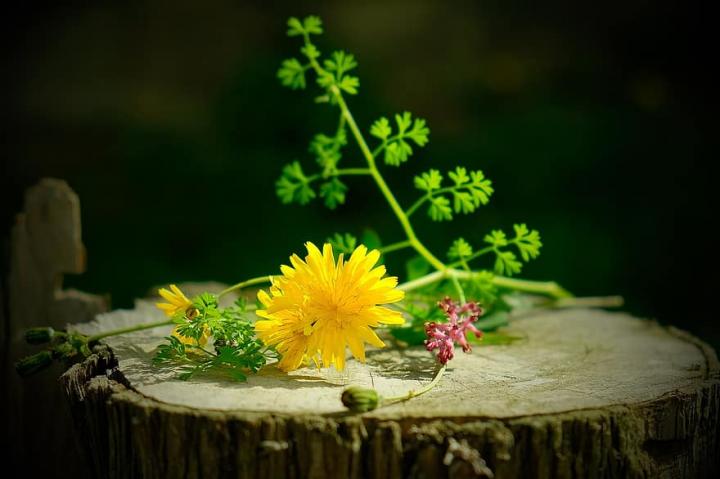
Photograph of a dandelion lying on tree stump

It is perhaps no surprise then that over the last few months, in daily lives typified both by anxiety and by ‘exercise outdoors’, The Wild Remedy flew off the shelves. Life in lockdown has interrupted so many of our connections. Entire relationships are conducted over Whatsapp; socially distant walks begin and end without hugs; love, mediated by Virgin Media, is susceptible to thunderstorms. The outdoors, on the other hand, can be seen, and smelt, and watched. The ground is damp when you kneel on it, and lichen is crisp between the fingers. Perhaps the gift of nature writing during this time is that when Zoom triggers fatigue, and screens make us want to wriggle, we feel our connections elsewhere more deeply.  

Mitchell leaves us with the knowledge that it is attention that creates connection, and presence that incurs discovery. These need not be hard work: a few pages of a book, at bedtime; being mindful, as you walk; a three-step breathing space, when you step outside. Then, miraculously, a darting smudge of green becomes a goldcrest. A bankside scurry becomes a vole. And when you return home after five months away, there are purple mushrooms in the Braid woodland, and wild raspberries in the hedgerows.  

© The University of Edinburgh. No part of this content may be used without prior written permission of the copyright holder.

Tiny Beautiful Wild Things

This piece was first posted as the Mindfulness Virtual Drop-in from the University of Edinburgh Chaplaincy

In 1995, the writer Cheryl Strayed hiked a thousand miles of the Pacific Crest Trail, aged twenty-six, alone. Four years earlier, Strayed’s mother had died of cancer at forty-five, just seven weeks after her diagnosis. The young woman’s life, marriage, and family fell apart in the wake of her sudden loss, and she became embroiled in heroin.

When Strayed decided to hike the Pacific Crest Trail, she did it – she said – in the hope that it would be her way back to being the woman her mother had raised her to be, rather than the woman she had become. And so she walked a thousand miles across the deserts and mountains of California and the forests of Oregon, past rattlesnakes and bears and cougar scat. In the desert, she rubbed sage between her hands and inhaled the scent, bright and fresh, as her mother had taught her, for energy.

Later, she became a writer. She wrote a memoir about her hike, called Wild, that topped worldwide bestseller lists in 2012 and was turned into an Oscar-nominated film. She also wrote a weekly column for the online magazine The Rumpus. In one of these, she wrote about what she would say to her twenty-something self, if she could speak to her now. She said:

‘One hot afternoon during the era in which you’ve gotten yourself ridiculously tangled up with heroin, you will be riding the bus and thinking [how worthless] you are when a little girl will get on the bus holding the strings of two purple balloons. She’ll offer you one of the balloons, but you won’t take it because you believe you no longer have a right to such tiny beautiful things. You’re wrong. You do.’

I thought about Strayed’s words when I read, some days ago, about the ‘rebel botanists’ who are using street graffiti to label the wild flowers growing in the cracks of streets, paths, and walls across Europe. They scrawl chalk with arrows to alert passersby to the daisies and the herb Robert, the scarlet pimpernel and the wild fennel – these tiny beautiful things that we don’t usually see.

I smiled when I read this, because a couple of weeks ago, on my daily walk in local woodland, amidst the usual green of dock and nettle I glimpsed something else: a pale green spike, like the hood of an elf, or the flame of a candle. When I saw it, I realised that the whole woodland floor was carpeted with pale green spikes. They were everywhere, rising out of the natural compost, glowing in the sunlight. I had walked through the wood every day for a week, and not noticed. These were wild arum lilies, also known as lords and ladies; the wild cousins of popular houseplants and the majestic titan arum of Indonesia. I love the arum lily, common as it is here in ditches and woodland, because its ethereal green flowers are hidden in plain sight. You don’t see them – and then suddenly you do, and you realise that, like magic, they are everywhere.

It could be woodland; it could be pavements (183 different plants, Sheffield); it could be walls (186 species, Cambridge). So many! Why didn’t I spot the arum lilies? Why do we not see the wild pansies in the sandy corner of a sun-baked wall? (They really are stunning, when you find one.)

Sometimes we look past the tiny beautiful things because we are busy; we are en route somewhere else. Perhaps we feel, as Strayed did, that we don’t deserve them because of our own personal failings. Or perhaps it feels, at this moment in our life, as if no small thing could be meaningful, given the magnitude of our suffering. In the time of coronavirus, perhaps we feel the burden of others’ sorrow so greatly that we feel guilty for enjoying a wild poppy. We have any number of ways to discount tiny beautiful things. In the case of wild flowers, we call them ‘weeds’, untidy disruptors of concrete and clean lines. But what else do we discount, if we turn away from what is small and beautiful? The tiny act of kindness, the smile, the purple balloon.

What if a tiny beautiful thing is not just one thing; what if, when you catch sight of it, you realise that it is all around; what if someone, somewhere, is drawing a chalk sign that says, let’s look at this together; and what if for every tiny beautiful arum lily that you see, there is a giant arum lily growing, silent and majestic, in the rainforests in Indonesia?

When we look at the world a different way, it speaks to us anew. William Blake saw ‘A world in a grain of sand, and heaven in a wildflower.’ When we look for the tiny beautiful things, we see what is large, and more beautiful. We are brought back to ourselves, and to each other.

This week, look for the tiny beautiful things. They may be wildflowers or birdsong. They may be your neighbours’ smiles across the road each Thursday, clapping for carers. The green of a tree. The colour of a favourite piece of pottery. A message from a beloved friend. A pile of really good books. The smell of flapjacks, made from oats at the back of the store cupboard, best before August 2016; or maybe a piece of chocolate, with this guided chocolate meditation.

Allow yourself to receive these. Dwell in them, soak them up. They are just as real as anything else that is hard and sad. But what we pay attention to matters, and if we don’t pay attention to the tiny beautiful things, we miss the answering hum of the world and its solace, amidst the sadness.

Soak up that hum, too; you are part of it. Mary Oliver wrote, in her poem ‘Sometimes’:

‘Instructions for living a life: Pay attention. Be astonished. Tell about it.’


© The University of Edinburgh. No part of this content may be used without prior written permission of the copyright holder.