
The Escape Artist

Avoidance and Other Disappearing Acts

This piece was first posted as the MindLetter from the University of Edinburgh Chaplaincy. You can subscribe by emailing mindfulness@ed.ac.uk. 

You have a meeting first thing, and you’re thinking about the email that came in at 6am. ‘Ready for school?’ you say to your child in the kitchen. The child is quiet, and looks withdrawn, as they have done for some time. You have to get to your meeting, so you head to your study.  

Your dissertation is due in a month. You are not sure what you are writing, and you are worried. You’re reading and making notes, but it doesn’t seem to be going anywhere. Hours go by. You have not achieved enough to earn a weekend off, so you try to work, but you seem just to wind up on Instagram. You are tired, and scared about the deadline.  

You have been living on your own during lockdown. It’s tough, and you have been drinking more than usual to wind down after work. You feel groggy in the mornings, and so you stop going for your run before work. This means you don’t sleep well, so you have an extra glass after dinner, too, to help you drift off. You slow down at work, and are starting to forget things.  

Do any of these look familiar to you? One of these scenarios may resonate more than others, depending on whether you are a parent, a student, a runner, or all of the above; whether you live alone, or not; whether you are a morning person, or not. 

But what ‘too much’ really means is that your personal history, multiplied by the unique set of circumstances in which you find yourself in this moment, divided by the resources you have to meet it, equals more than 1. The parent’s meeting is perhaps the culmination of a big project; his child’s unhappiness makes him uncomfortable, because he was unhappy at that age, too. The student was a star pupil at school, but she has no job lined up for when she graduates, and she is terrified of failing. The runner was doing OK despite the lockdown until her cat died, suddenly.  

The balance tips. It happens to all of us. And when stresses are multiplied, as in exceptional times, we may be surprised at the strength of our own reactions. But in the simplest terms, when you are operating at more than 1, you start running on an energetic and emotional deficit. What happens next

1.     The Stress Equation

As the camera pans over the Edinburgh skyline, the setting for our story becomes clear: it’s stress. It’s seeping up through the floorboards, washing around the main characters as they head to the meeting on Teams, sit grimly at the computer on a Saturday, and turn off the alarm, groggy and headachy.  

Simply put, the parent, the student, and the runner are experiencing stress because they are experiencing too much: information, emotion, time alone, unstructured time, maybe even red wine.  

‘Too much’ is, on the one hand, subjective. We all know someone who can take phone calls while also brilliantly comforting their child at 6am, or spend weeks happily in their own company, or down several pints on a Friday night and come top of their age group in the Park Run the next morning. This means that we may be tempted to tell ourselves, if we are struggling, that we are ‘being weak’. When it comes to others, we may indulge in competitive stressing, to establish that we have more to be stressed about than they do.  

But what ‘too much’ really means is that your personal history, multiplied by the unique set of circumstances in which you find yourself in this moment, divided by the resources you have to meet it, equals more than 1. The parent’s meeting is perhaps the culmination of a big project; his child’s unhappiness makes him uncomfortable, because he was unhappy at that age, too. The student was a star pupil at school, but she has no job lined up for when she graduates, and she is terrified of failing. The runner was doing OK despite the lockdown until her cat died, suddenly.  

The balance tips. It happens to all of us. And when stresses are multiplied, as in exceptional times, we may be surprised at the strength of our own reactions. But in the simplest terms, when you are operating at more than 1, you start running on a deficit. What happens next

2.     The Escape Artist 

The main character of our story is not the parent, the student, or the runner. The main character is the mind. 

The mind under stress typically responds in one of two ways. It may jump in and try to solve the problem: fixating, ruminating. The parent, up too early reading emails, is doing this. But then something else happens – the child is unhappy – and rather than jumping in, the mind withdraws. The parent literally leaves the room. 

Later, he may berate himself for not lingering a little longer; he may even internally accuse himself of being a ‘bad parent’. But this is the same mind that learned, on a visceral level over many millennia, to bolt at the hint of a large be-furred face in the grassland. The mind looks to escape under stress for very good reason: there are times when running, jumping, or flinching can save our life. Lions aside, avoidance of what’s difficult makes an awful lot of sense. And usually, it’s fine to wait until the meeting has passed to check in with the child; it’s sensible to question whether your thesis is going in the right direction; a glass of good wine is a pleasure in a quiet evening.  

The problem arises when we get really good at it: when the deficit accumulates over time, as with chronic stress, or happens all at once, as with trauma. When this happens, the mind turns escape into an art form, and the mind will react to emotional threats as if they are lions. Fear that our child is unhappy, fear of the future, or frustration with a lonely lockdown, morph into a be-furred face. And so we may leave the room either literally, or metaphorically. The student hides from her thesis; the runner disappears into Scotch.  

What happens next? 

3.     Escalation 

Here’s the thrust of the plot: if the mind chronically escapes, things may get worse before they get better. A child’s silence stretches into months, and the parent retreats into work. The dissertation is fumbled together in a sleepless last week, and the student’s self-criticism is entrenched. Perhaps the runner, who no longer runs, slides into depression.  

Things get worse because escaping, well-intentioned as the fight/flight system is, moves further away from the emotional nub of the matter. Emotions like fear, anger, and sadness are as old as the first human who ran from a lion. But for the stresses where fleeing doesn’t work – with the child, the dissertation, the loneliness – we must try something else.  

What might that look like? 

Photograph of a woman running on a road away from the camera. There are trees in the background and the sun setting

The escape artist thrives on two things: automaticity, and isolation. Interrupting its Cirque-du-Soleil-type flight through the air means addressing both of these. 

First, step out of automatic pilot. Learn to recognise your triggers, and your reactions. Which scenario above did you relate to? Which cause of stress, and which response? You may find it helpful to write these down, in a diary, or on a post-it.  

When you can start to recognise these as they occur in daily life, you are already doing something different. In the moment that you spot it, pause and settle yourself with a three-step breathing space. Later, put aside twenty minutes to explore it in more depth, with a RAIN practice. 

Second, step out of isolation. We often feel tremendous shame around our stress responses. We may perceive that they make us look weak, or fear that they will burden others. But they are as human as the very blood in our veins, and you are not alone. Message a loved one, or call someone you trust.  

We can make sense of the stories that we carry inside us; we can catch our own escape artist in the act. Some will surrender their running shoes swiftly, others may take more patience, inquiry, and support from outside. But the genre can be changed. The next act is unwritten.

© The University of Edinburgh. No part of this content may be used without prior written permission of the copyright holder.
Going to Ground

This piece was first posted as the Mindfulness Virtual Drop-in from the University of Edinburgh Chaplaincy. You can subscribe by emailing mindfulness@ed.ac.uk. 


A few weeks ago, on a morning walk, I came across a spectacular carpet of morning glories. Otherwise known as bindweed, these marshmallow pink flowers grow rapaciously on scrubby ground in the summer months. True to their name, they are open and most glorious first thing, when the sun is up; by the afternoon they have folded in a tight pink whorl, waiting for the next beams of morning light. In gardens they are often uprooted, but if left undisturbed in farmland and hedgerows, they will roam over the ground without limit, like a green and pink web of delights for visiting bees and butterflies.

There was no other way to appreciate these ground-dwellers on a glorious morning: I sat down on the sun-baked earth, and settled in to watch the flowers and their visitors. Slowly but surely, peace, like the beetles, crept over me.

When we think of going to ground, it often has a fearful quality. We think of how rabbits disappear into their burrows at approaching footsteps, or a mouse bolts below the skirting boards. Indeed, with no burrow in sight, it is a profoundly animal pattern to drop to the ground in times of terror or distress: think of how a gazelle cornered by a lion will freeze, and fall.

Humans are just the same. In a moment of shock, we crumble to our knees, or say, ‘I need to lie down.’ In Eat Pray Love, the writer Elizabeth Gilbert describes how during the years of the breakdown of her marriage, she spent nights on the bathroom floor. The ground offers us something: as I wrote a few weeks back, even being in contact with it through walking activates the pressure receptors in the soles of the feet, helping to meet the body’s neurological need for touch.

To see what the ground gives back, you might watch how that gazelle, apparently felled, can bolt for freedom at the predator’s momentary inattention; how a human’s blood pressure rights, as they fold to the floor in a faint (ouch); how Gilbert’s prayers on the floor opened her to a guiding voice within. Going to ground gives us time. It allows us to replenish. Indeed, given the time of year, and your need for a holiday, many of you as you read this may actually be horizontal – or wish you were.

But the ground is not only palliative. As the dancers among you will attest, our bodies’ relationship with the earth is also the source of some of the most beautiful forms of art. Watch a contemporary dancer roll and lift from the ground, in a seamless wave of motion; or a Cuban salsera, or a tap dancer. You will see how going to ground does not only restore us to baseline: it makes new and rather wonderful things possible.

Here, then, is some ground beneath your feet this week.


  1. GRAIN, For Hard Times

I’ve introduced Tara Brach’s RAIN practice to you before as a way of responding wisely to fear, worry, and illness. The practice’s four stages – Recognise, Allow, Investigate, Nurture – are a very helpful way of using your attention to explore and tend to the experience of stress.

Sometimes, however, if distress is acute, or RAIN is unfamiliar as a practice, it is difficult for us to move attentively through this process without losing the thread, or getting sucked into the worry. My colleague from the Oxford Mindfulness Centre, Chris Cullen, talks about the value of Grounding first, by sensing the feet on the floor, and the seat on the chair. This allows the mind to begin to shift mode out of the fight-flight response. Indeed, once you have grounded, and are moving through RAIN, you might return the attention to the feet and the seat, in between its stages, to help steady the attention as you explore the practice.

In particularly sticky moments, simply attend for a few minutes to the soles of the feet on the floor, and the sit-bones on the chair. ‘FOFBOC’ – succinctly standing for ‘feet on floor, bum on chair’ – was developed by the Mindfulness in Schools Project, as a brief practice to help teenagers’ minds to settle at the beginning of class. It’s a great one to do regularly, so that the attention learns to settle in these places, and your ground is ready and waiting in the moments you need it.


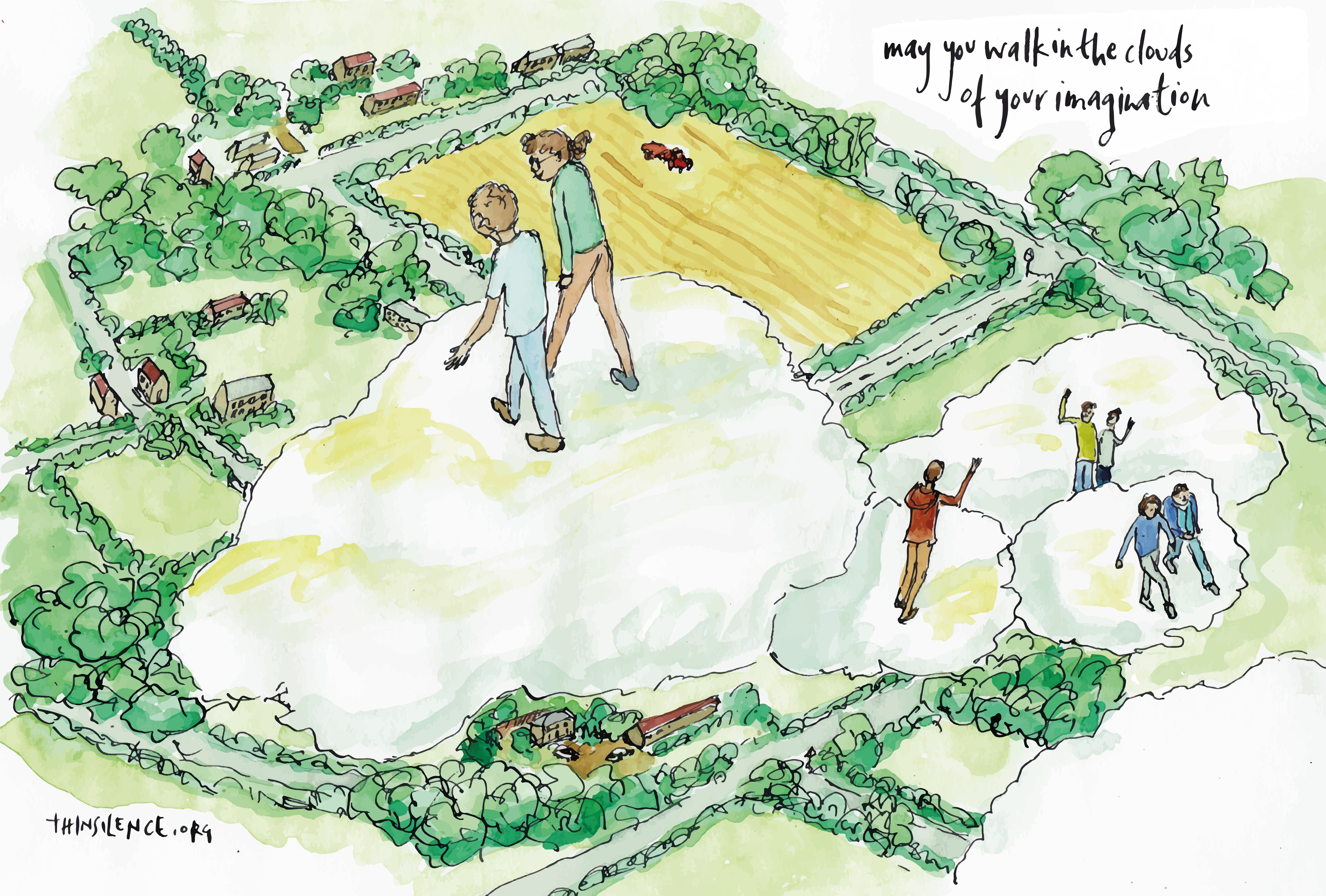
  1. Your Head in the Clouds

Leaving the ground can be one of the most exhilarating experiences known to humans. Think of the plane taking off to a faraway land, the phrase ‘flight of fancy’, the rollercoaster, the simple pleasure of climbing a tree. There is a reason that the penthouse is the preferred floor.

Extraordinary things can happen when we go up. But we also sense, with animal blood in our veins, that leaving the ground carries a risk to it. Those who are afraid of flying, who prefer the stairs to the lift, are in touch with this very basic fear. The idea of strange and frightening things happening when we go too high appears across literature; think of Mrs Rochester in Jane Eyre’s attic, or the vicious Knids in Roald Dahl’s Charlie and the Great Glass Elevator. Dahl, who was an RAF pilot during the Second World War, was well aware of what can happen in the sky.

One of the most interesting facets of creative thought is that it takes what is already here, and transforms it into something new. Creativity is literally grounded. The plane depends on the ground, and must return to it, to take off once more – otherwise, at some point, it will find itself running on fumes.

So use FOFBOC – not just when you are stressed and low, but at work, or play, when the adrenaline begins to peter. Take your project on a walk, and feel your feet on the ground. Dance out your energy, and feel, like the dancers do, the heels and balls of the feet, and the sense of a shuffle or spin.

We see and feel things differently from the ground. From a cognitive perspective, we shift in mode. We gain insight into problems, whether of heart or mind. When we have our feet on the ground, they support our head in the clouds. Like the contemporary dancers, we can create something new, and beautiful.


16 may you walk 3
thinsilence.org


© The University of Edinburgh. No part of this content may be used without prior written permission of the copyright holder.

Staying on Holiday at Home

This piece was first posted as the Mindfulness Virtual Drop-in from the University of Edinburgh Chaplaincy. You can subscribe by emailing mindfulness@ed.ac.uk. 


Staying on Holiday at Home

Scotland has shifted towards re-opening dentists, hairdressers, and cinemas. There are new possibilities for physically-distanced socialising, and staying somewhere overnight. And many of us are thinking: could I…might I…go on holiday?

As in: GO on holiday. Pack a suitcase, get in the car, get on a train. Marshal the hand sanitizer and the DIY masks. Buy too many snacks, and forget rubber bands to tie around the half-eaten ones, so that the bottom of your rucksack fills with peanuts. Take after-sun instead of sunscreen. You know the drill.

After nearly four months in lockdown, you may be desperate to escape the confines of your city or village; your bags are half-packed as you read this. Or you may be horrified at the thought of having to put yourself through all of the above, with an added dose of re-entry anxiety.

Rarely, in our University, have we had more people in need of a holiday, with less energy, clarity, financial means, or choice about it. And so more of us will be tucking the guidebooks out of sight, and staying at home this summer.

Staying on holiday at home – after a time in which you have been not so much working from home, as at your home, in a crisis, trying to work – turns particular features of ‘holiday’ upside down. There is none of that satisfactory change in gear that we used to get by arriving home and putting the work laptop in a dark corner with its notes unfinished, because it’s 7pm and you have a plane to catch. The boundaries are murky, if not gone.

‘Boundaries’ are so useful, because they don’t just mark things as different from each other – they create space in which each can flourish as it is. The work/home boundary is so useful, because by enabling us to put work away, we can attend to what’s important at home in its own right: cats, children, a homemade pizza, a courgette plant. This, in turn, enables us to recover more effectively from depletion at work – which often makes room for curiosity and creativity in our work.

So the boundary between work and holiday protects and nourishes both. But with more of us staying at home this summer, in spaces that have become pervaded by work, we will need to be creative about reclaiming holiday as holiday, and home as home. If, like me, you are staying at home for your break this summer, here is what to expect – and how to find rest, and maybe even some joy, in the midst of it.


1.     Holiday Dread

Holiday dread comes in many forms. You dread shutting down your emails, because work, with its structure and connection, has been a life-line. You dread taking time off because it only reminds you of the holiday you had to cancel. You dread having time to spend with and around your family or flatmates, because they need more from you than you are able to give right now. You dread taking a holiday, because you live alone, and the last thing you want is more time with yourself.

This is completely normal. If you have been under stress, and your holiday is impending, the mind triangulates every stressful moment from every holiday you’ve ever taken, and multiplies it by every awkward conversation, or loneliness, in the last month. Then it creates a prediction, based on this lovely subterranean machination, about just how dreadful the next two weeks will be.

Start to spot the mind’s predictions as they pop up in the mind. Notice how they attach themselves to those last bits of work business, as you finish up on a Friday. If you’re really rundown, they will even tag along to your moments of happy anticipation, just to make sure that you don’t forget that you should be worrying.

Be gentle with your mind in this moment; it is your age-old fight or flight system, trying to help. As you put away your computer, and cook yourself meals that aren’t pasta with pesto for the first time in weeks, those thoughts will begin to soften and settle.


2.     Holiday Bugs and Blues

If you’ve been ticking along at work, feeling a bit tired or grumpy, but basically doing ok, you may find that the first few days of your holiday are unexpectedly…not as great as that wonderful week you spent in the South of France, with the local red wine, and the market garden tomato salad.

Aches and pains may surface. Day two of your holiday sees you in bed with a migraine. The hayfever you’ve been combatting turns into a cold. (Hopefully not a cough.) And – you may feel lower than you expected. Small irritations explode into big ones, as you worry about the effect of iPads on a generation of small eyes and minds, and dread your inbox on your return to work.

As we start to relax, and the firefights of work and study fade, the new space gives way to what was waiting in the wings. Some of these can wait; others will make themselves urgently felt.

Give them space, gently. Wrap up your migraine in an eye mask and blanket; take your worries to a friend, on a walk. When you feel better, give yourself permission to put the irritation away. Thank goodness, at this time when the kids can’t hug their friends, that there is Peppa Pig – and Sally Rooney on iPlayer.


3.     Holiday Frenzy

As I wrote a few weeks back, when you’ve been looking forward to time off, it’s possible to get very excited about all the things you’re going to do. Your glass is not just half-full, it’s a glass of that wonderful red wine from the South of France.

Depending on your individual flavour of frenzy, you could be envisaging two weeks of: self-improvement, catching up on emails, Netflix, intensive home-schooling, or reading six months’ worth of Times Literary Supplements, which are currently sitting in the corner of the hallway still in their plastic wrappers. (No comment.)

We all wind up needing a holiday from our holiday from time to time. This year, of all years, it’s so important that we spend our precious time off doing what nourishes us, and reminds us who we are. There are many lovely things, big and small, in our lives – even amidst uncertainty, and sorrow. We want to be open to them, and allow them to fill up our drained and depleted minds and bodies.

And: we want to be gentle with ourselves. Your body has been sitting still, in a too-small chair, for a long time. Your mind has had to read pixelated faces for many months. Your heart has been troubled, and determined, in equal and often competing measure. This is tiring, and you may only come to understand how deeply so when you pause, and notice.

So be kind to yourselves, on your holidayat home. Allow it to be a holiday. Allow it to be home. Know that it will be messy – and that that’s just fine, and could even be quite fun.


© The University of Edinburgh. No part of this content may be used without prior written permission of the copyright holder.

Trouble Sleeping

This piece was first posted as the Mindfulness Virtual Drop-in from the University of Edinburgh Chaplaincy. Open to all, you can subscribe by emailing mindfulness@ed.ac.uk. 


‘It’s late and I’m feeling so tired,’ sings Corinne Bailey Rae. ‘Having trouble sleeping…’

It’s a sentiment familiar to many. A King’s College London study finds that two thirds of us have experienced some negative effect on sleep since the pandemic began, with a disproportionate impact on women, young people, and those facing financial difficulties. Intriguingly, though, most of us are sleeping more than we did pre-lockdown. With commuting shelved, and no pub to go to on a Friday night, total sleep time is actually up – it’s just not so restful.

So what might this look like? You may find yourself sleeping in fits and bursts, with long periods of wakefulness in between; waking groggily early in the morning, and watching the clock until it’s time to get up; finding it hard to fall asleep at all. You may have unusually vivid dreams, and remember more of them when you surface. If you have recurring stress dreams, or nightmares, these are probably putting in more of an appearance during your slumbering hours at the moment. They may be specifically about the pandemic, or they may be older stress patterns, flaring up with new potency thanks to the extra layer of lockdown worry-fog.

As we go about our days tired and stiff, the worst part of disturbed sleep is often creeping dread or anxiety about it. Sleep can become a place in our minds that is not restful, a sanctuary to enter at the end of the day, but rather a site of stress and fretfulness. We fear not sleeping – or if we sleep and have nightmares, we fear sleep itself. The other week I came across a passage that captured this cycle perfectly, in The Long Winter, by Laura Ingalls Wilder. An autobiographical children’s book, it depicts a ferocious seven-month winter in the tiny settler town of De Smet, South Dakota, in the 1880s.

Sometimes in the night, half awake and cold, Laura half-dreamed that the roof was scoured thin. Horribly the great blizzard, large as the sky, bent over it and scoured with an enormous invisible cloth, round and round on the paper-thin roof, till a hole wore through and squealing, chuckling, laughing a deep Ha! Ha! The blizzard whirled in. Barely in time to save herself, Laura jumped awake.

         Then she did not dare to sleep again. She lay still and small in the dark, and all around her the black darkness of night, that had always been restful and kind to her, was now a horror. She had never been afraid of the dark. “I am not afraid of the dark,” she said to herself over and over, but she felt that the dark would catch her with claws and teeth if it could hear her move or breathe.

It’s a poignant description of how fear can flavour sleep and the wee hours. Unseasonal though The Long Winter might be, there’s reassurance in knowing that trouble sleeping, in the face of trouble, is an age-old experience. The psychological impact of endless howling prairie blizzards, with no end in sight, is not unlike that of being steeped in uncertainty and hard news.

So how might we look after ourselves in the face of sleeping troubles, and soften some of those internal blizzards? Here are some ways of responding, when sleep goes haywire.


1.     Find Your Rhythm

Your body has powerful circadian rhythms. It wants to rest, and when it doesn’t, it will find a way to make it happen – as we’ve all discovered at one time or another, falling asleep after lunch. Fortunately, there’s a lot of wisdom out there on sleep hygiene: practical steps to realign the body’s sleep/wake cycle. During a tricky sleep patch, it can feel as if it will take forever to get back on track. But our circadian rhythms thrive on routine. Sleepio, for example, is an effective cognitive behavioural therapy app, that intervenes pragmatically and quickly to reset sleep patterns. But a few simple steps – a time limit on your smartphone in the evening; re-establishing some daily exercise – can also promptly make a difference.

Simple though such moves are, entrenched habits often get in the way. A quick message turns into twenty minutes on Twitter; rain clouds gather, and your walk looks less than inviting. Autopilot is a powerful thing, so outsource the willpower on this. Delete that app, and charge your computer in a different room overnight. None of us can quite be bothered to walk next door, at 3am, in order to scroll through BBC News.

Part of the misery of sleep disruption is that it can feel mysterious. If it has been relatively short-lived, cast your mind back and make a note of what triggered it. Often this is something quite straightforward. It could be that the heat kept you awake, that you missed a walk or online exercise class one day, or that a difficult message last thing at night had you up for hours. Re-establish your usual routines as soon as you can, bookmark any difficulty that requires some attention, and be patient with yourself: you will be a little slow and tired at first, but you will find your rhythm soon.


2.      The Tell-Tale Mind

When it feels, as it did for Laura Ingalls, that the dark awaits you with claws and teeth, this is because your stress system is amped up. Thoughts scurry around in the mind, and your body holds itself up away from the bed, poised to fight or flee. As you try ever harder to fall asleep, rest seems more and more elusive, and you worry ever more about what will happen tomorrow.

The mind tells powerful tales about the past and the future. As if its usual fears and worries weren’t enough, many of its stories may be about what will go wrong if you don’t sleep enough, or what has happened to cause your restlessness. We may try to fight our thoughts, angrily batting them away, generating more thoughts about how badly this night is going. Remind yourself that thoughts are not wrong: they are your mind trying to help, but because you are tired and stressed, it is helping in a way that is tired and stressed.

Instead of trying to stop the thoughts, see if it’s possible to label them gently as they come up: ‘here is planning; here is self-criticism; here is prediction.’ Thoughts, you will notice, come and go: they are flickering, not solid. So you might imagine that your thoughts are like a waterfall, and that they can just fall past you as you sit beside them. You may get a little damp, but the thoughts need not drench you; and imagine that your seat beside them is soft, and comfortable.


3.     Creature Comfort

When the mind is whizzing with memories, and plans, and what-ifs, the body as it lies here is not the past and future. It’s just the back, and the backs of the legs, and arms and head, against the sheets and pillows. So gently practice bringing your attention into the places where the body is held up: the surface of the skin, the texture of the sheets. When your mind veers off, acknowledge the story it tells, and just come back. You are reminding yourself that you are a body, safe and supported in this moment, in this space – nowhere to go, and nothing to do. Often, people find that a body scan helps provide some structure for this. It’s something you can do with the track a few times, and then just by yourself.

Often, as the mind quietens, sleep comes naturally. But sometimes you may realise that you are physically uncomfortable. You may be too hot or cold; you are hungry or thirsty. Tune in to what you most need, in this moment, and give yourself permission to follow it through. We are creatures, not floating brains.

‘Daytimes were not so bad as the nights,’ Ingalls Wilder wrote. ‘The dark was thinner then and ordinary things were in it.’ And so in daylight hours, when the dark is thinner, give some attention to the ordinary things that may make your sleep more comfortable. A soft blanket, a fresh pillow, a turned mattress; an open window for the smell of summer air; and something lovely to look at, when you open your eyes in the morning.


© The University of Edinburgh. No part of this content may be used without prior written permission of the copyright holder.

Interrupting a Spiralling Mind

This piece was first posted on For Times Like These: Blogs from the University of Edinburgh Chaplaincy to help us through COVID19 lockdowns and meltdowns, and to raise our spirits. 

A couple of weeks ago, I wrote about how the mind usually reacts to stress and difficulty. One typical reaction is that we ruminate: the mind creates an endless thread, infinite possible scenarios in the imagination, all with the underlying sense that if we can only think of everything and pre-emptively solve it, we’ll be ok.

Sometimes we do eventually wind up at a solution, and it’s that sense of hitting the idea jackpot that reinforces the compelling feel of this mental process. It works! We think. Except, of course, all the times that it doesn’t, and instead keeps us up at 3am, or side-tracks us on an afternoon of remote working…

Unpleasant though it can be, a spiralling mind is a fascinating thing to watch. ‘I am an old man and have known a great many troubles,’ Mark Twain is reported to have said, ‘but most of them never happened.’ If you observe closely, there will be an initial trigger: it could be an article or Twitter post that you read, a comment from a friend, a frustrating email. Sometimes, the trigger is itself a creation of the mind. An apparently harmless amble along a familiar mental track takes an unexpected twist, and then, like racehorses out of the gate, we’re off, thoughts bolting for the distant finish line.

When the trigger for a spiralling mind occurs, if you were to slow the moment right down, you would notice two things happen next. First, something physical: a lurch in the stomach, a stony cold feeling in the face, shoulders hunching, chest tightening. These bodily signs are completely normal. They’re an indication of the second thing: an emotion has been triggered. Fear, anger, sadness, and anxiety all show up in the body, and we often feel them physically before we realise that they’re present.

It’s emotional charge that gives the spiralling mind its energy. Emotions are the wind in the mind’s sails. You will have noticed this in good moods, as well as bad: an excited mind will spiral joyously, just as a sad mind will spiral despondently. This makes sense when we consider that emotions are a call to action – a sign for us to attend, and take care. Our mental resources prick up their ears, and get to work.

The trickiness of a spiralling mind is that because of its very energy, it rapidly takes us far away from whatever initially needed attention and care. It will zoom into past, future, and parallel universe, at great speed. Indeed, if you watch the spiralling mind play out, it has the rapidly rotating quality of a hurricane: it hoovers up every relevant fragment of memory, attention, and imagination available. What is ‘relevant’ is governed by the emotional charge. If you are feeling low, memories of previous times you felt low will play across your mind, as if feeling rubbish right now weren’t bad enough. This, incidentally, is why recurring depression feels so hard, because actually it’s not just the weight of this moment on your shoulders; it’s the weight of every other low moment you’ve ever had, bearing down on this one right now.

As well as dredging up the past, and making predictions about the future, the spiralling mind will hone in on everything in the here and now that seems to back up those racing thoughts. Run out of milk? Worry about that, too. Friend not picking up their phone? Fuel to the fire.

When we recognise this process, it’s tempting to get in there and problem-solve. How can I make it stop? Why am I up at 3am yet again? But at this point our problem-solving is running off the storm system itself. When the hurricane of thoughts, emotions, and body sensations gets going, we need something equally powerful to interrupt it – but of a fundamentally different nature.

If the spiralling mind runs on habitual networks of memory and hyper-vigilance, we need deliberate, open, and embodied attention. One of my favourite definitions of mindfulness comes from Ellen Langer, who describes it as ‘…a flexible state of mind in which we are actively engaged in the present, noticing new things and sensitive to context’. The spiralling mind cannot survive an open, flexible, and inquiring awareness, just like wildfire cannot leap across a big enough gap.


The Three-Step Breathing Space

Zindel Segal, one of the creators of Mindfulness-based Cognitive Therapy for recurring depression, describes how he, Mark Williams and John Teasdale created a short practice intended to make just this gap. The three-step breathing space is ‘about moving attention in specific ways to help us free ourselves or to get unstuck,’ he writes, and you can try this lovely guided track for it from Mark Williams.

Sometimes called a three-‘minute’ breathing space, the practice can be done in just a few minutes, or extended to longer if you wish. It has three key parts:

1) Acknowledging what’s here in your experience right now: your mood, thoughts, emotions, body sensations. There’s no need to change these, just notice what’s here, with some friendliness.

2) Gathering the attention to the sensations of the breathing somewhere that feels steady, like the abdomen. Notice this in-breath, and this out-breath, just as they are, breathing themselves.

3) Expanding the awareness, to include the whole body sitting, standing, or lying down, just as it is, being itself.

Practice this a few times with the track, and then try doing it by yourself: the beauty of the breathing space is that it’s portable. To remember its steps, you can use the acronym AGE: Acknowledge, Gather, Expand. In our mindfulness courses, we encourage people to practice it two or three times a day in ordinary moments. This helps train the attention to follow its hourglass shape – broad awareness, narrow, broad – so that in those moments when the spiralling mind’s tug is strongest, we have this internal resource at our fingertips.

The breathing space is a short practice, invisible to the onlooker, and can be easy to underestimate. Yet course participants and trainee teachers tell me that there have been times when the breathing space has saved their lives. It does not fix our problems, or make situations go away; at the end of it, there may still be strong thoughts and feelings around. Things still need our attention, and action.

But what the practice does is create space. Space, far from being a vacuum, is potent. Sometimes, it is enough at the end of a breathing space to notice, ‘wow, I really am upset right now,’ and to attend to that with care. At their simplest, the gap around the wildfire and the pause in the storm offer a chance for this moment to be different than it would have been otherwise. Short, and deceptively quiet, there are days when the breathing space’s slivers of difference make all the difference.


© The University of Edinburgh. No part of this content may be used without prior written permission of the copyright holder.